Working with password-protected documents can be frustrating, especially when the password slips your mind. Over the years, I've encountered numerous situations where crucial files were inaccessible due to a forgotten password. This isn't just an inconvenience; it can halt projects, delay critical information sharing, and cause significant stress.
Recently, a colleague approached me with a particularly vexing problem: an important project proposal, finalized and saved as a PDF, was locked with a password they could no longer recall. The deadline was looming, and the file contained vital details that couldn't be recreated quickly. It was a classic case of a forgotten PDF password, and the pressure was on to find a solution.
Table of Contents
Understanding the Issue
PDFs are a ubiquitous format for document sharing, offering a consistent look across different platforms. However, password protection adds a layer of security that, while beneficial, can become a hurdle if the credentials are lost. This protection can be for opening the document or for restricting actions like editing or printing.
Types of PDF Passwords
It's important to distinguish between two types of PDF passwords: the 'owner' password and the 'user' password. The owner password restricts modifications and printing, while the user password prevents the document from being opened altogether. My colleague's situation involved a user password, meaning the file was completely inaccessible without it. Recovering a forgotten PDF password for this type is often more complex.
Initial Attempts and Frustrations

Our first instinct was to try common password variations: the colleague's name, significant dates, pet names, and common word combinations. This is often the go-to for anyone facing a forgotten password protected pdf. Unfortunately, none of these yielded results, suggesting the password was more complex or perhaps entered incorrectly during the initial saving process.
We then considered the possibility of brute-force attacks, but this often requires specialized software and can take an extremely long time, especially for strong passwords. Given the tight deadline, this wasn't a viable immediate solution. The frustration was palpable; a critical document was locked away, seemingly out of reach.
Exploring Solutions for PDF Unlock Success
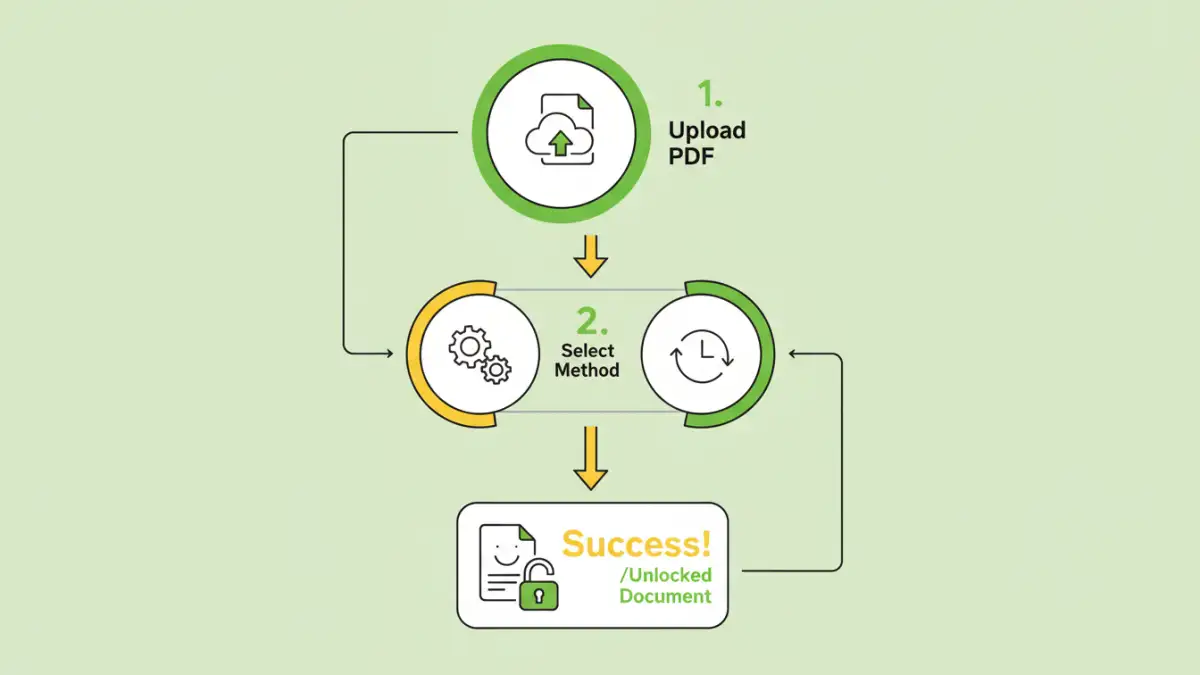
With the clock ticking, we began researching methods for PDF unlock success. This involved looking into various software tools and online services designed to help recover lost passwords. It's crucial to approach these tools with caution, especially online services, as uploading sensitive documents carries inherent privacy risks.
Online vs. Desktop Tools
Online tools offer convenience, often requiring no installation. However, their effectiveness can vary, and privacy is a major concern. Desktop software, on the other hand, generally provides more robust features and better security as the file doesn't leave your machine. For a critical document, a desktop solution seemed more appropriate.
The Recovery Process in Action
We decided to try a reputable desktop PDF password recovery tool. These programs typically employ a combination of dictionary attacks (trying common words and variations) and brute-force attacks (trying every possible character combination). The effectiveness depends on the complexity of the original password and the power of the software.
The process involved installing the software, loading the password-protected PDF, and configuring the recovery settings. We opted for a hybrid approach, starting with a dictionary attack using a comprehensive wordlist, and then moving to a brute-force attack if the dictionary failed. It took several hours, but eventually, the software successfully identified the password. The relief was immense as we finally gained access to the document.
Lessons Learned and Best Practices
This experience reinforced the importance of robust password management and secure document handling. While recovering a forgotten PDF password is sometimes possible, prevention is always better than cure. It highlighted the need for better record-keeping and more secure, memorable passwords.
Always use strong, unique passwords for your sensitive documents. Consider using a password manager to store them securely. If you need to restrict access, think about whether an 'owner' password (restricting edits/printing) would suffice instead of a 'user' password that locks the entire file. Document access recovery can be stressful, so proactive measures are key.
Comparison Table: PDF Password Recovery Methods
| Method | Pros | Cons | Best For |
|---|---|---|---|
| Manual Guessing | Free, Immediate if successful | Low success rate for complex passwords, time-consuming | Simple or commonly used passwords |
| Online PDF Unlock Tools | Convenient, no installation required, often free for basic use | Privacy concerns, can be slow, limited features, may not work for strong encryption | Quick unlocks for less sensitive documents, owner passwords |
| Desktop Recovery Software | More powerful, handles various encryption types, better privacy | Requires installation, can be expensive, recovery time varies greatly | Complex or unknown user passwords, critical documents |
| Password Managers | Secure storage, auto-generation, organization | Requires setup, not for recovering *forgotten* passwords (unless stored), subscription costs | Preventing password loss in the first place |