Navigating the digital landscape often means encountering documents created with older software or in outdated formats. These files can present a significant hurdle, preventing easy access, editing, or integration with current systems. Ensuring that these older files remain usable is crucial for maintaining business continuity and preserving valuable information.
The challenge is common: a critical report from a decade ago, a scanned contract in a proprietary format, or an archive of presentations that won't open on a new machine. My own experience has shown that the frustration of not being able to access or work with these essential pieces of information can halt projects and create unnecessary delays. Fortunately, modern PDF technology offers robust solutions to bridge this gap.
Table of Contents
Understanding the Challenges with Legacy Documents
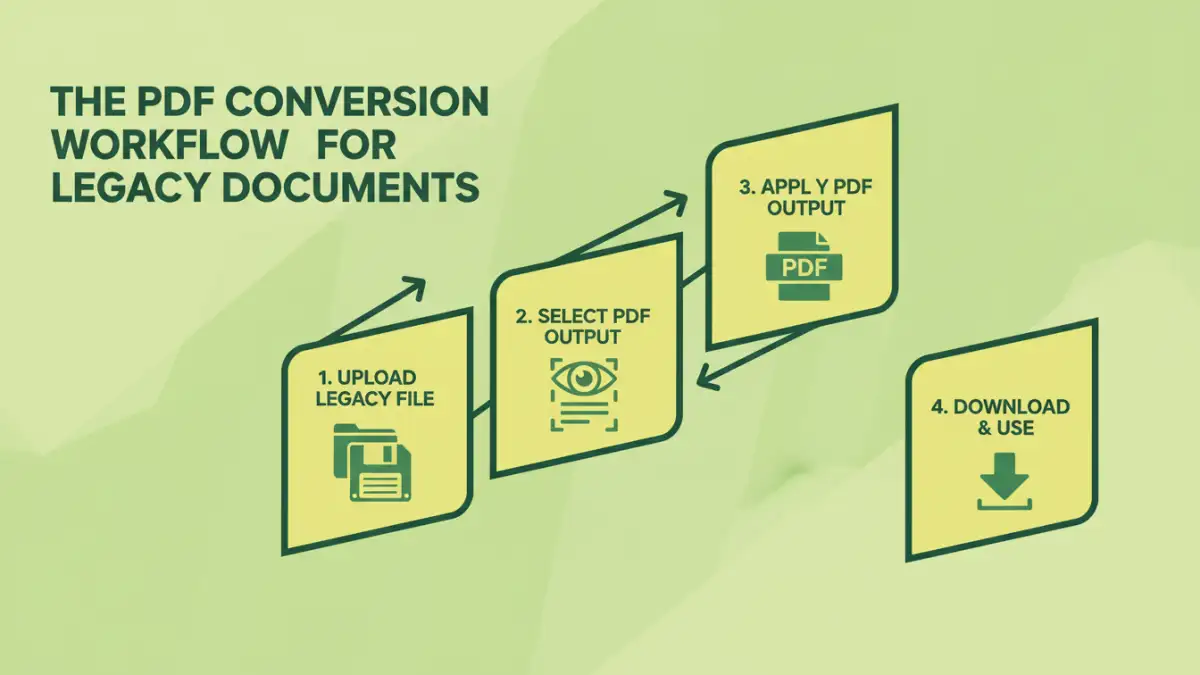
The primary difficulty with legacy documents lies in their format's obsolescence. Software that created them may no longer be supported, or the file structures themselves might be incompatible with current operating systems and applications. This can lead to data corruption, rendering issues, or complete inaccessibility, posing a risk to the information they contain.
Common Obstacles
Beyond simple incompatibility, legacy documents can suffer from issues like embedded fonts not being available, complex formatting that doesn't translate well, or proprietary metadata that is lost during conversion. Scanned documents, often saved as image files with limited text recognition capabilities, present their own unique set of challenges for modern usability.
PDF: The Universal Translator for Documents
The Portable Document Format (PDF) has emerged as a de facto standard for document exchange and archiving. Its strength lies in its ability to preserve the original formatting, layout, fonts, and images of any source document, regardless of the software used to create it. This makes it an ideal solution for ensuring long-term accessibility and consistency.
When a legacy document is converted to PDF, it essentially becomes a self-contained, universally readable snapshot. This process simplifies sharing, viewing, and even secure storage, as the PDF format itself is widely supported across virtually all platforms and devices, offering excellent legacy document compatibility.
Leveraging Modern PDF Tools for Compatibility
Modern PDF software and online tools go far beyond simple file conversion. They offer sophisticated features designed to handle a wide range of legacy formats and improve overall document usability. These tools can often import documents from various old file formats and export them into pristine, editable, or universally viewable PDFs.
Key Features for Conversion
Many contemporary PDF editors include OCR (Optical Character Recognition) capabilities, which are vital for converting scanned documents or image-based PDFs into searchable and editable text. Batch processing is another invaluable feature, allowing users to convert multiple legacy files simultaneously, significantly saving time and effort.
Effective Conversion Strategies
The approach to converting legacy documents often depends on the original file type and desired outcome. For text-based documents like old word processing files, direct conversion to PDF usually yields the best results. For scanned documents, using an OCR-enabled PDF tool is essential to make the text selectable and searchable.
When dealing with highly complex layouts or proprietary formats, it's sometimes beneficial to perform an intermediate conversion. For instance, converting an old CAD file to a common vector format before importing it into a PDF editor can preserve more detail than a direct conversion. This ensures that the final PDF accurately represents the original, enhancing pdf compatibility across different systems.
Best Practices for Digital Preservation
To ensure ongoing legacy document compatibility, adopting best practices is crucial. Regularly review your document archives and identify files in outdated formats that may pose a future risk. Prioritize conversion of critical documents and establish a standardized process for handling new documents to prevent future compatibility issues.
Consider using PDF/A, a specialized version of PDF designed for long-term archiving. It restricts certain features that are not suitable for long-term preservation, ensuring that documents remain accessible and viewable far into the future. Implementing a robust document management system can also help track and manage your converted files effectively.
Comparison Table: Document Conversion Methods
| Method | Pros | Cons | Best For |
|---|---|---|---|
| Direct PDF Conversion (Software) | High fidelity, preserves formatting, editable options, batch processing, OCR support. | Requires software purchase/subscription, learning curve for advanced features. | Complex documents, high-volume conversion, preserving original look and feel. |
| Online PDF Converters | Quick, easy to use, accessible from anywhere, often free for basic use. | Potential privacy concerns with sensitive documents, limited features, file size limits, less control over output. | Simple documents, occasional conversions, non-sensitive files. |
| OCR for Scanned Documents | Makes scanned text searchable and editable, improves accessibility. | Accuracy depends on scan quality, requires OCR-enabled tools, can be time-consuming for large batches. | Archiving paper documents, making old scanned files usable. |
| Intermediate Conversion | Can preserve specific elements from very old/complex formats (e.g., CAD to vector). | Adds an extra step, potential for information loss at each stage, requires knowledge of multiple formats. | Highly specialized or complex legacy formats where direct conversion fails. |